1. The concept of Impact-Driven Growth (IDG)
The fundamental learning is that growth should not be an end in itself, but a consequence of generating real impact.
- From "output" to "outcome": The framework proposes shifting from measuring success by the number of tasks or features delivered (outputs) to focusing on business results and user value (outcomes).
- Strategic alignment: IDG acts as a bridge between business vision (the "why") and tactical execution (the "how"), ensuring that every technical or creative effort moves the needle on key KPIs.
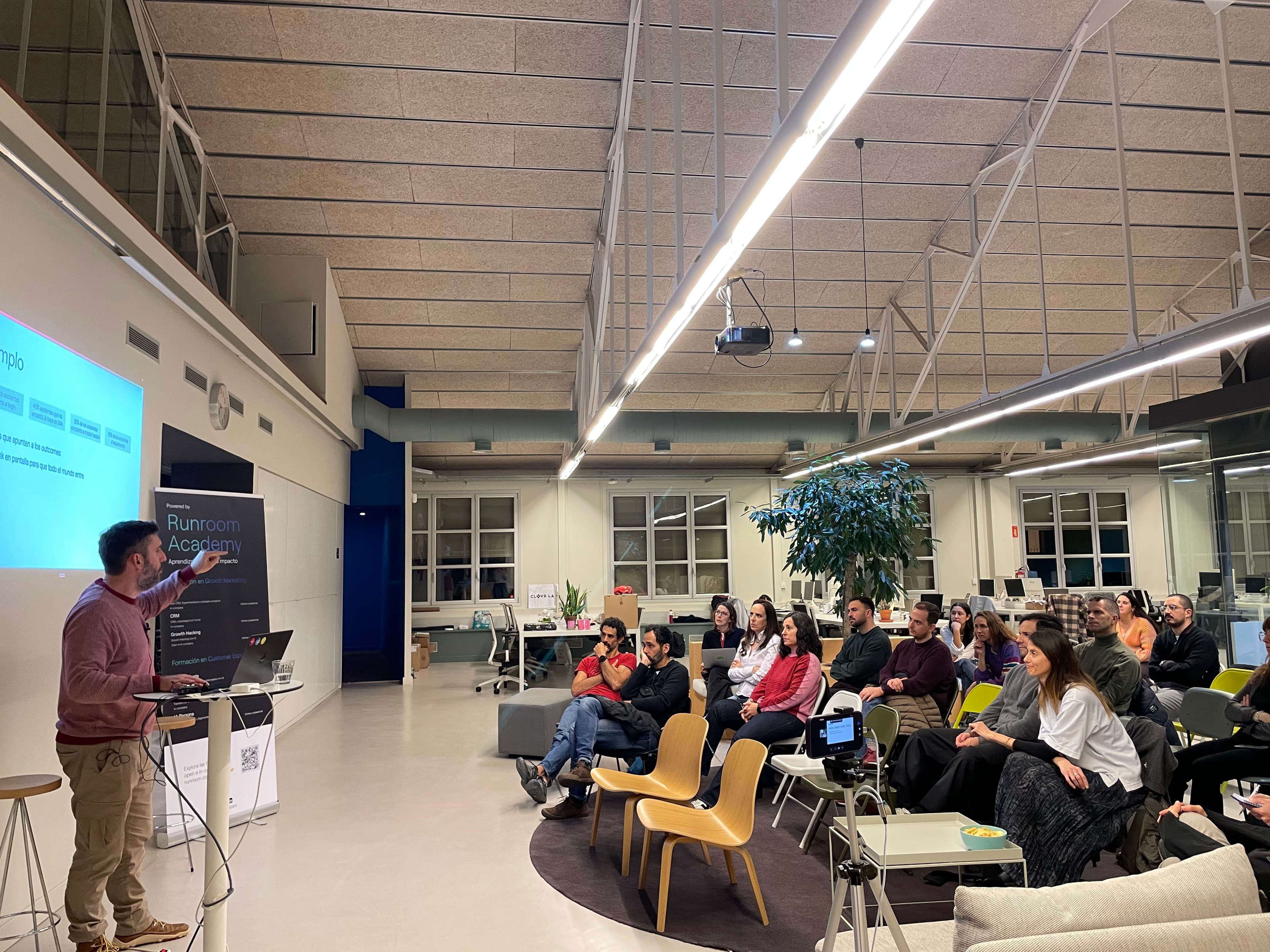
The major novelty of the LAB was the presentation of a proprietary technology developed by Runroom and based on AI, designed to operationalize the Impact-Driven Growth™ framework.
This technology helps you:
- Define your impact strategy
- Identify key metrics and Outcomes
- Formulate structured impact hypotheses
- Detect the critical risk of your strategy
- Build a detailed experimentation plan
- Design a clear plan to validate impact hypotheses
AI does not execute for you. It guides, structures, and accelerates your strategic thinking with considerable results:
- Democratization of strategy: AI allows any team to apply the IDG framework in a guided manner, reducing the friction of the learning curve.
- From analysis to action: The tool not only analyzes data but also helps prioritize growth hypotheses based on impact potential and technical feasibility.
- Contextualization: Unlike generic AI, this tool is trained with Runroom's specific methodology, ensuring consistency in the generated growth plans.
Tell us how it goes, if you see results, and if it helps in your strategy. We would love to receive your feedback on the experience!
3. Key learnings about the methodology
- Continuous Experimentation: Impact-driven growth requires a lab mindset. It's better to launch small experiments, measure, and pivot than to plan large projects blindly.
- From "North Star Metric" to "CPVM" (Customer-perceived Value Metric): Carlos emphasizes the importance of defining a unique metric that guides the entire organization, preventing departments from rowing in opposite directions. Unlike the North Star Metric, which focuses on the business and is unique and constant, the CPVM focuses on customer success, measuring the exact moment when the user obtains the value they were seeking.
- Waste Reduction: By focusing on impact, tasks that do not add real value are eliminated, optimizing team resources.
Conclusions
- AI as an accelerator, not a substitute: The conclusion is clear: Runroom's AI does not replace the human strategist, but enhances them, eliminating the "fear of the blank page" and structuring strategic thinking ultra-fast.
- Impact Culture: Adopting this framework requires a cultural shift in companies: moving from a "doing" culture to an "achieving" culture.
- Operational Efficiency: The combination of the IDG framework with proprietary AI tools allows agencies and consultancies to offer much higher value in less time, transforming the traditional service model.
"Growth is not the goal, it is the consequence of consistently delivering value."