Realworld
Google Marketing Live 2026: The Agentic Era Begins Now
Google Marketing Live 2026 was not just another update. It was the unveiling of a new board. Google is rebuilding its entire advertising stack around Gemini and made it clear: those without well-connected data, clean feeds, and a strategy aligned with the agentic era are simply not playing.
Araceli Iglesias, Performance Media Lead at Runroom, analyzes the four major blocks of the event —Search & Commerce, YouTube Performance, Measurement, and Agentic Marketing— and what they mean for advertisers who want to remain competitive: from AI Max for Search coming out of beta with a +27% increase in conversions, to Ask Advisor as a unified interface for managing the entire Google ecosystem through a single conversation with AI.
Last week, the latest EMEA edition of Google Marketing Live 2026 was unveiled, and I have the feeling that this edition marks a new curve in the sector. Another one. Every year I say it's the most relevant, but this time it seems Google wants to change its board completely. If in 2023 we talked about generative AI as a new layer over existing products; in 2024 and 2025 we saw how it was integrating into Search and Performance Max; by 2026 the discourse is different. Google is going to rebuild its entire advertising stack around Gemini and has made it clear from the main stage. However, as always, learning will first take place in the United States, and we will see how all these new features are incorporated over the months.
"We own the full stack. We don't rent our intelligence."
The central message repeated by Debbie Weinstein (EMEA President) and Steph Davis (VP Customer Solutions EMEA) was directed: the advantage of Gemini is the advantage for your business. The promise is a direct connection from Google's labs (chips, research, models) to customer results. A stack that moves faster than any competitor because it doesn't depend on anyone else. Everyone is losing money in the race, but Google is clear it will reach the finish line.
For those of us who have been in this since before mobile changed everything (👵🏻), this bet has a very clear reading: they want to turn execution into a commodity. Steph Davis verbalized it without hesitation: it's not just about knowing how to set up campaigns, adjust bids, or manage keywords. What differentiates now is the criteria, strategic thinking, the ability to decide what to do and why. This forces the conversation with the client to move. And our internal one too. Does Impact Driven Growth ring a bell? If it doesn't, I recommend you take a look.
Before diving in, the figures that support the entire presentation (all official Google):
- 2.5 billion monthly users in AI Overviews
- Queries in AI Mode are 3 times longer than traditional searches
- AI Max for Search comes out of beta with a track record of +27% in conversions
- Google and YouTube are present in 82% of all purchase journeys
- Combining them generates +40% ROAS compared to other media (MMM study with TransUnion)
- 1 billion hours/day of YouTube consumption on TVs
- When a creator talks about your product on YouTube, the viewer is 13 times more likely to search for your brand
The session was structured around four major pillars: new era of Search & e-commerce, performance on YouTube, measurement with ROI verified, and agentic marketing. Let's go step by step.
New era of Search & Commerce
The first block was led by Shashi Thakur (VP Search Ads) and Brandon Ervin. The thesis is that the old trade-off between making an intelligent decision and making it quickly has disappeared. Before, making an informed purchase meant opening 15 tabs and praying; today AI Mode returns a personalized recommendation in seconds. And consumer data confirms it: 75% of users feel more confident making decisions with AI Overviews. But the data that really raised my eyebrow is another. Once users start using AI Mode, they use ChatGPT less for shopping. It's the first time I've heard Google frame Search as a direct competitor to ChatGPT in purchase intent. For anyone in doubt about the battle being fought, there it is. They have been testing it since last year, we'll see how long it takes to become a reality, but AI Max will be the one piloting these ads.
AI Max for Search comes out of beta
What was a promise last year is now a live product. AI Max comes out of beta with a +27% increase in conversions, according to Google, capturing that conversational intent that manual keywords couldn't cover. Long searches like "hotels with views of the Eiffel Tower and breakfast included but cheap" previously didn't find ads. Now they do.
It's worth reading this +27% with a magnifying glass. On what baseline? In which verticals is it concentrated? And what about the cost per conversion and the quality of the lead that comes in? In accounts where every euro is meticulously controlled, we've seen that the promise of volume sometimes comes with inefficient matchings. The figure is attractive but not inherent. Each business will have to validate this expectation. However, not doing so is not an option, let's be clear.
What's new this year:
- AI Max for Shopping: extends the AI Max framework to standard Shopping campaigns, not just Performance Max. It leverages Merchant Center feeds to match against conversational queries instead of exact product searches.
- AI Max for Travel: specific variant for the travel vertical.
Oliver Kiderle (Product Lead for Search) said it unequivocally during the Q&A: AI Max will be the best practice from now on for any advertiser trying to capture all demand in AI-driven search experiences. This means that accounts operating solely with restrictive manual keywords are immediate candidates for migration. It's competitive survival.
AI Brief: the control we've been asking for
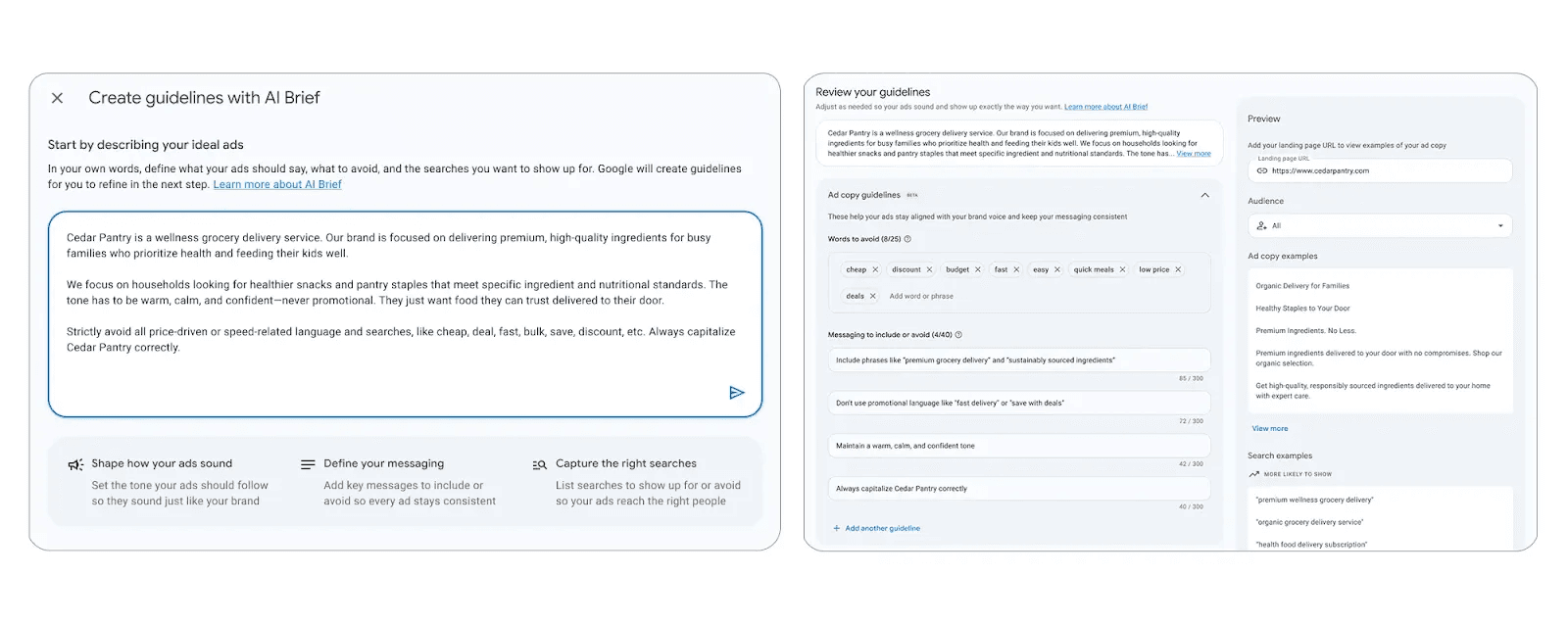
This is probably the novelty that interests us most as consultancies and agencies. One of the historical complaints with PMax and AI Max has been the black box feeling. You launch the budget and pray it works well the first time. AI Brief arrives to solve it.
It's a conversational interface within AI Max, powered by Gemini, where you indicate in natural language:
- Messaging guidelines: what you want the ads to say and, most importantly, what you don't want them to say.
- Matching guidelines: what types of searches to prioritize or avoid.
- Audience guidelines: who you want to reach and who you don't.
The big advantage over massive lists of negative keywords or exact matches? With searches becoming conversational and long, it seems the negative model is quickly falling short. AI Brief allows expressing intent in natural language and maintaining control over how the brand is expressed. Brandon Ervin showed the interface live: it even generates previews of how the ads would look before launching them. This is gold for regulated sectors, clients with very strict brand guidelines, or contractual conversations where the client needs to see that we maintain control over the message.
Rollout: first in English for AI Max for Search, then Performance Max and AI Max for Shopping.
Direct Offers
Direct Offers enter AI Mode in the United States. They allow offering high-intent users something exclusive at the exact moment of decision. And they're not just classic discounts. It also covers local coupons and personalized offers. The advertiser provides the products and rules, and Gemini handles individual matching for each buyer. We'll see when it lands in Europe.
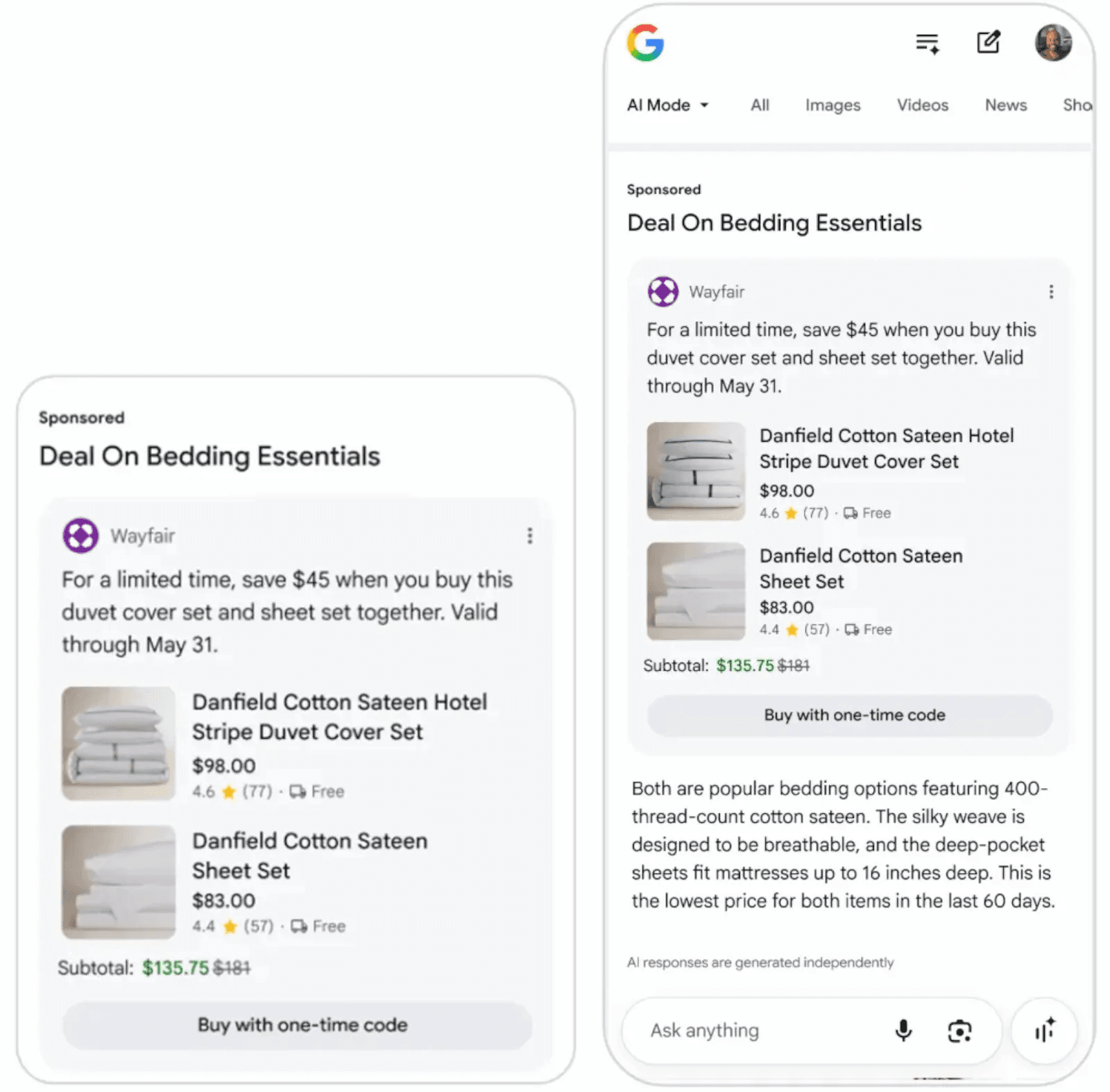
AI-Powered Shopping Ads
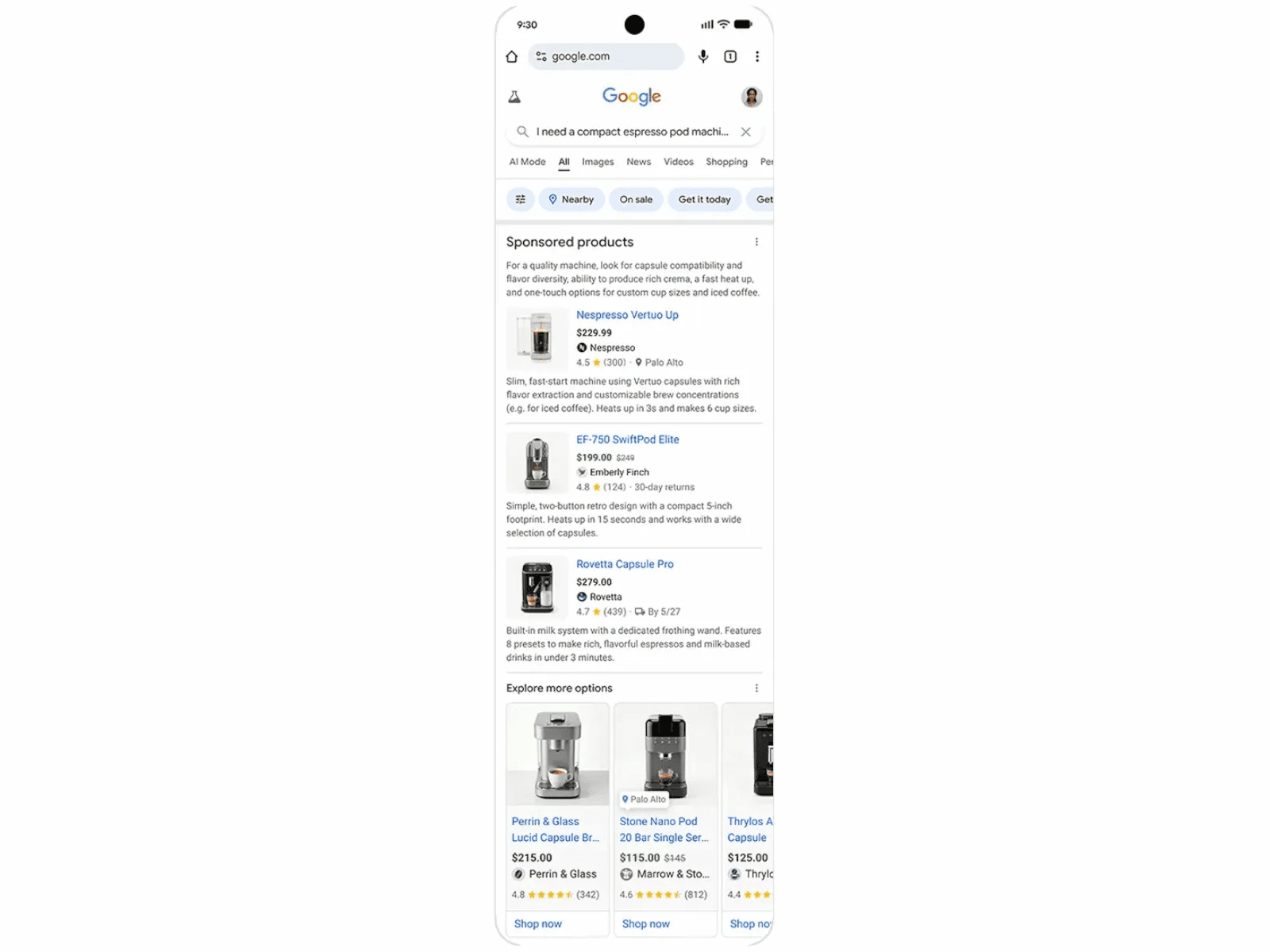
When a user searches for "a capsule coffee maker that fits on a small countertop and makes iced coffee", AI Mode returns the typical shopping ads but with a considerable upgrade: three curated ads with key product features written in natural language, not as a technical sheet. They only activate in PMax and the new AI Max for Shopping campaigns.
Business Agent for Leads
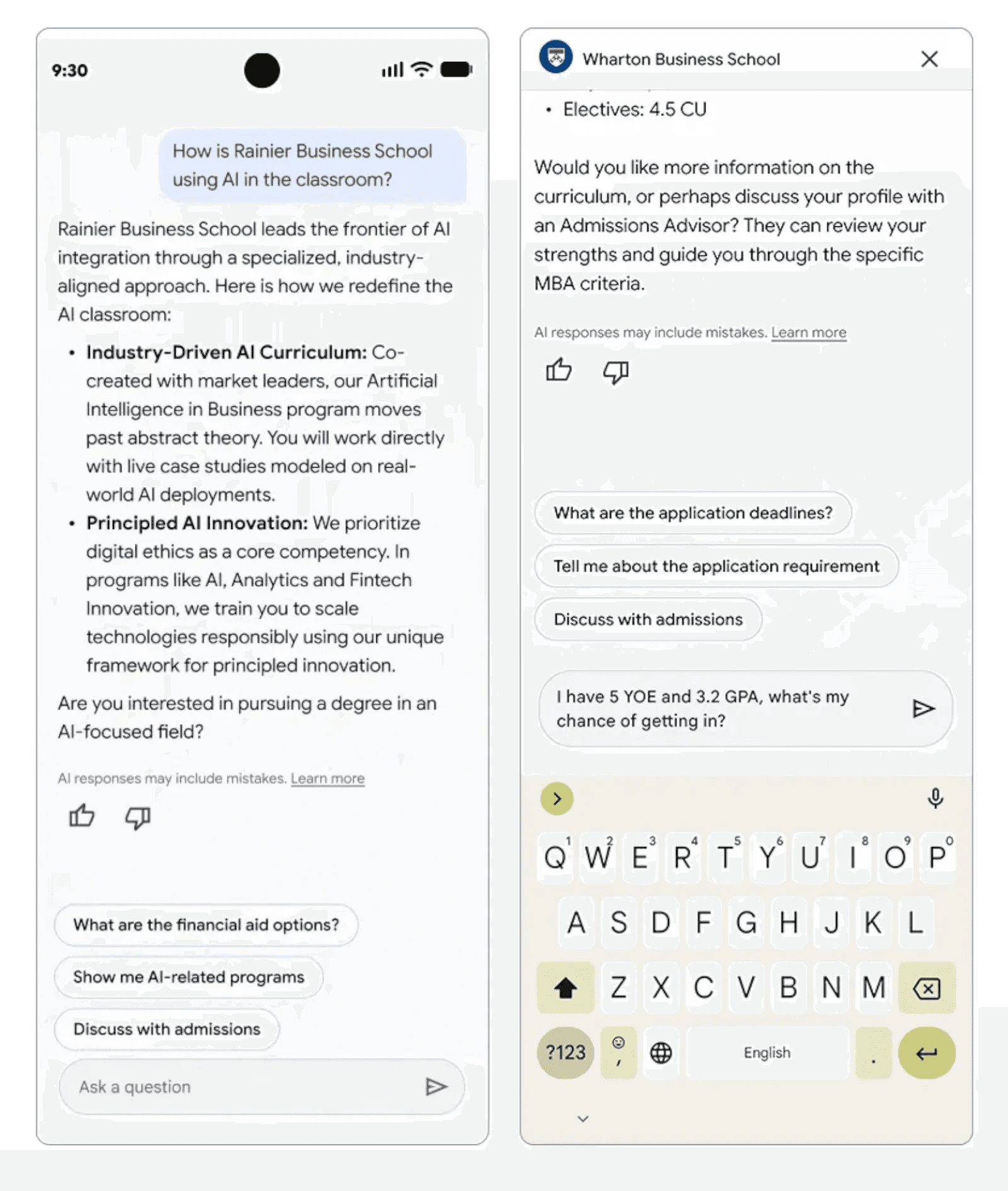
This is the novelty I see the most opportunities for clients with long sales cycles. Within an ad, the user can ask questions and get answers powered by the advertiser's website content. If logged in, their data is pre-filled, generating a much more qualified lead than usual.
Google is testing it with companies in the US, UK, India, and Canada across various verticals. For B2B verticals where the lead arrives cold and cools further as they browse the web, this can be a considerable change.
Agentic commerce begins to take shape
The second block was led by Dan Taylor, who heads the shopping stack at Google. His opening phrase already sets the tone: "We are entering the era of agentic commerce".
For an agent to buy on behalf of the user, the entire infrastructure (catalogs, inventories, payments, checkouts) must speak a common language. And here Google has made one of the most strategic announcements of the event.
Universal Commerce Protocol (UCP)
UCP is Google's bet for an industry standard that allows AI agents and merchant systems to communicate with each other without friction. In Europe, there are already powerful names operating with it. Zalando and Carrefour are letting their live inventory and loyalty data flow directly into the search result.
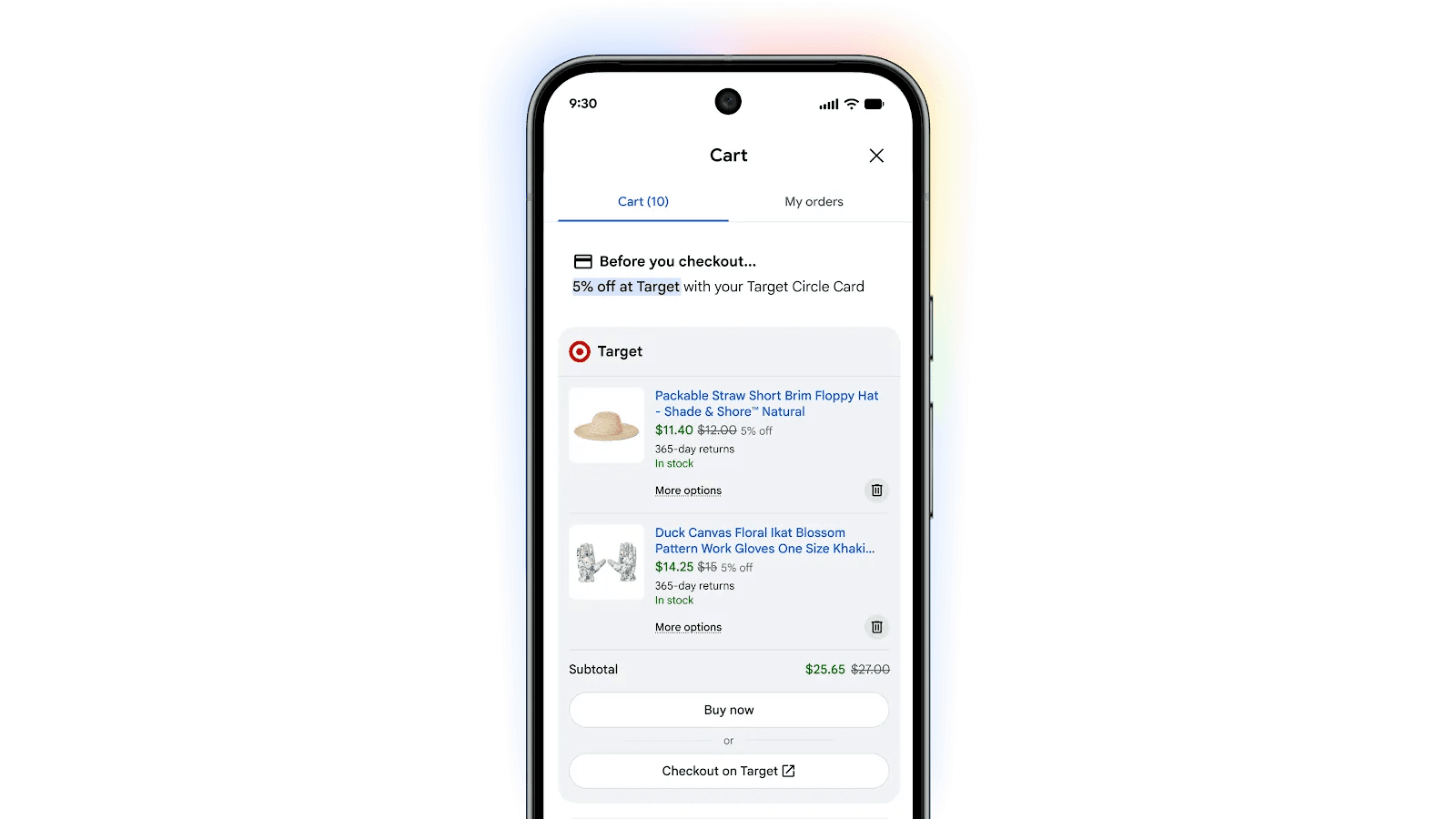
Why does it matter for our retail clients? Because if you have a catalog in Merchant Center with clean and updated feeds, you are eligible for all the new layers: Universal Cart, Native Checkout, Direct Offers in AI Mode. If you don't have clean feeds, you're out of the game. This turns feed management quality into a strategic lever, not an operational one. Where before you could survive with a mediocre feed, now you're directly out of the conversation.
Universal Cart
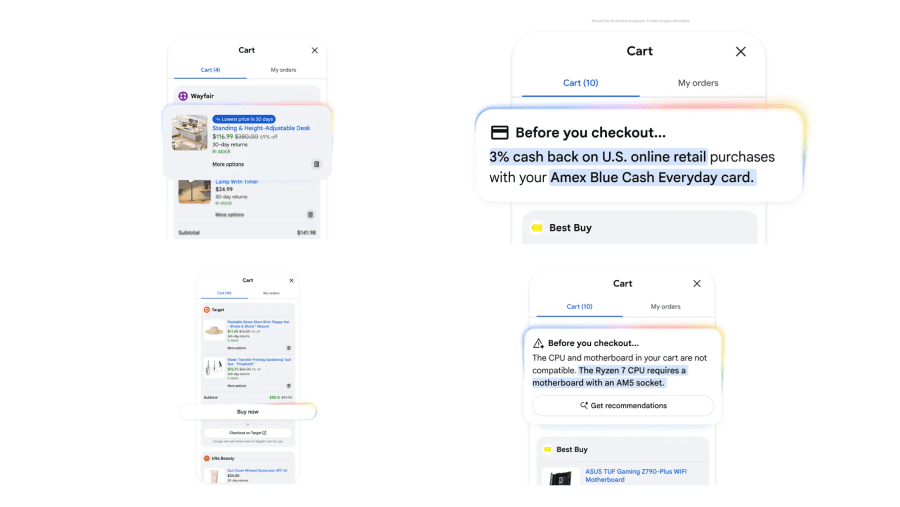
The Universal Cart will arrive in the United States in the coming months, first in Search and the Gemini app this summer, then in YouTube and Gemini. It works as a unified cart between brands and Google surfaces. When you add a product:
- Automatically tracks price changes
- Notifies you when it's back in stock
- Works on Gemini, so it improves as models improve
Native Checkout
Retailers configured with UCP in the United States will be able to complete the purchase within AI Mode with a single click. The user sees the Direct Offer, clicks Buy now, and the offer is automatically applied at checkout.
Same concept extended to YouTube. Shoppable ads where “Buy now” opens a branded checkout within YouTube with payment via Google Pay. Dan Taylor framed it as reducing the friction between "I want something" and "I bought it". And here is the underlying change: the funnel physically shortens. The video and conversion stop being in two separate places, stop being two different metrics, stop being the responsibility of two different teams. This will have organizational implications in any medium-large ecommerce.
Asset Studio rewritten with Gemini Omni, Veo 3.1, and Nano Banana
Google's creative studio is completely redone. Asset Studio now integrates:
- Veo 3.1 for video
- Nano Banana, DeepMind's model for professional photography
- Gemini Omni, the new multimodal model that processes and generates text, image, and video simultaneously and announced in this presentation.
- Natural language interface: you explain the brief and it generates variations
- A/B Testing in one click: you choose the most promising assets, click Save and create test, and the system pits them against your best current ads
- Open API for large advertisers generating thousands of variations
The data justifying the effort is compelling: creativity drives up to 49% of incremental sales. That is, almost half. And the connection with other tools also changes: Asset Studio imports from YouTube Studio, Product Studio, Pomelli, Canva, and Adobe. The question for us is what happens to human creativity in this new scenario? It doesn't disappear, obviously. But the dragon needs training. Just as in 2023 we talked about Midjourney, in 2026 we need to learn to leverage Asset Studio because it's where ads will be cooked. At Runroom, we've been doing several tests, and its power stands out, especially if what interests you is time to market rather than having the perfect piece.
Powerful updates are expected for this coming year.
Pomelli for SMEs
Pomelli is the Google Labs tool that makes the most sense for small clients or teams with little creative bandwidth. You paste the website URL, and it generates on-brand images and videos instantly, ready to insert into Asset Studio. For clients without their own creative team or budget to produce much, this significantly lowers the barrier.
Performance on YouTube: the platform is no longer just awareness
Third block, led by Melissa Hsieh Nikolic, Director of Product Management for YouTube Ads. The thesis: YouTube is no longer the top layer of the funnel; it's a measurable performance engine that should be included alongside Search and PMax.
YouTube Creator Partnerships within Google Ads and DV360
Another important announcement. Google is integrating Creator Partnerships as a unified space within Google Ads and DV360. It allows:
- Search creators by keywords
- See which creators are relevant to your brand
- Contact them and orchestrate sponsored content from the same place
- Measure partnership metrics
The figure that matters? Working with authentic creator assets generates a +20% conversion lift. YouTube has 3 million creators ready to collaborate with brands.
Boost creator videos directly in the asset picker
Operational detail that will save a lot of manual work. No longer need to first publish the creator's video on a channel and then go looking for it. From Demand Gen, you can boost the creator's video directly in the asset picker during campaign setup.
Cross-campaign reach & frequency
New beta very interesting for brand advertisers. It allows grouping different campaigns and making them work together towards a unified reach or frequency goal. Without this, historically, massive reach and impact campaigns could overlap for the same impact.
YouTube vs Paid social
The data Melissa put on the table:
- YouTube generates 1.3 times higher ROI than paid social
- Example: in Germany, 55% of YouTube Shorts viewers are not on TikTok (i.e., different audience, not cannibalization)
- Engaged views (more than 5 seconds viewed) versus social scrolling: more solid metric to demonstrate impact
Demand Gen as the winning horse
The data on Demand Gen is the most impressive of the block:
- +30% average growth in conversions over the last 6 months
- Works in any vertical and with any budget
- Reaches Google Maps as its own inventory, opening a very powerful new channel for retail with physical stores
- New vertical feeds (automotive, for example) and AI-assisted campaign setup
- Adding it to your PMax and Search campaigns yields +10% in ROAS and +12% in sales effectiveness
- Display will be engulfed by this consideration machine starting in 2027.
Measurement and verified ROI: finally metrics that speak to the CFO
Fourth block, led by Harikesh Nair and, in the subsequent panel, Suzanne Claassen with Lisa Jakobovits, Jessica Nussbaum and Anjali Raghaavan. The argument is compelling: in an AI era, no innovation matters if your measurement base doesn't capture it. And here Google announced what is probably the most structural change of all GML2026.
Two new metrics: ABS and QFC
- Attributed Branded Searches (ABS). Links the fact that a user sees an ad on YouTube or Demand Gen with AON campaigns, with that same user later searching for your brand on Google. It's the cleanest proof to date that your advertising is generating brand intent, especially useful when the final conversion falls outside the short attribution window.
- Qualified Future Conversions (QFC). Analyzes the key actions the user takes right after seeing your ad and uses AI to causally connect them with future sales up to 6 months later.
For verticals with long consideration cycles (real estate, financial, B2B, education), this is gold. Finally, we can justify top-of-funnel investment with defensible metrics to the CFO.Together, ABS and QFC offer what Harikesh called speed and truth. Short-term signal and long-term signal in the same dashboard.There's still little information, and it seems there will be an associated cost for it to be statistically viable to measure, but it's very good news.
Meridian within Google Analytics 360
Meridian, Google's open-source MMM (Marketing Mix Model), enters Google Analytics 360. This is what breaks the silo. For the first time, you can analyze performance on Google, Pinterest, TikTok, Snapchat, Meta, and others in one place, with cross-scenario planning capability. And there's more:
- Key MMM solutions coming shortly
- A new Incremental Attribution Model in limited alpha this year, which will show incremental results continuously within the GA property
- Conversational agentic capabilities so you can literally "talk" to your data in GA
They also announced a new open-source GeoX package as part of Meridian, which can be linked to the MMM for a unified view
Data Manager and Google Tag Gateway
The foundation of everything. Data Manager unifies the connection of online, offline, and CRM data. The data:
- Advertisers who enrich with first-party data via Data Manager achieve an average +11% incremental ROAS
- Google Tag Gateway, Google's first-party tagging solution, delivers an average +14% in conversions
It's worth noting one thing: when Google says data strength, it's not marketing. It's a prerequisite. Without clean and well-connected data, neither generative AI, predictive models, nor Ask Advisor (next block) will perform. If in 2023 we said you had to invest in your own data, in 2026 without it, you're not playing.
Critical operational detail that cannot go unnoticed. As of June 15, 2026, Google Signals and Ads Consent Mode configurations become destination-specific. That is:
- Google Signals will control the data you use in Google Analytics
- Ads Consent Mode will control the data you use in Google Ads
The cookies and IDs you collect from the tag or SDK will be separated according to what they are used for. If you decide to set ‘ad_storage’ to ‘denied’ by default in Ads, audiences, bids, and conversions will be affected. For example, remarketing lists may decrease in size.Before June 15, audit configurations for all clients.
Agentic marketing: Ask Advisor consolidates everything
The event's closing was led by Steph Davis with one of the most powerful announcements. The consolidation of the entire family of Google agents, which had been in dispersed production across different products for a year, into a single advisor: Ask Advisor.
What is Ask Advisor
Ask Advisor unifies Google Ads, Google Analytics, Google Marketing Platform, and Merchant Center into a single conversational interface, built on Gemini and with shared memory. The agent remembers the user's goals as they move between tasks.
Examples of questions it would answer:
- How do I optimize a campaign for new customer acquisition?
- Show me abandoned carts of new vs. existing customers, by region
- How should I budget for the next quarter? (and does scenario planning)
Status: beta for English accounts, with a broad rollout during the year.
And that's all for this year. Now we just have to wait to see when all these new features are implemented because some from last year are still pending. We know we'll be hearing about these topics for at least the next 6 months, if not delayed. It seems we'll have to start reserving budget to cover all the needs that will arise, whether technical, creative, or new functionalities.
Let's talk
Tell us about your challenge, and we'll explore how to turn it into a growth opportunity together.