Stooa, Agile Development of a Fishbowls Tool

Areas
Investigación y estrategia de palabras clave. Design research. User personas. Behavioral insights. Testing de conceptos. Dual Track Agile. Product Trio (Product Manager, Designer, Developer). Agile methodologies. Orientación a outcomes e impacto
Promoting smooth communication that breaks down silos between areas of knowledge is essential for creating agile and collaborative contexts within organizations. Therefore, in Agile environments like Runroom, rituals, methods, and dynamics that foster dialogue, feedback, and ideation, such as fishbowls, are key. A type of unconference event that allows for participatory and self-managed debate among large groups of people.
During the pandemic, bringing this dynamic to the virtual environment seemed necessary to maintain the bond between runroomers and preserve our agile ecosystem. But were we the only ones with this need? What was happening in other organizations?
Thanks to the research and iteration process we tell you about in this case, we managed to turn an intuition into reality. And thus, Stooa was born: the first online fishbowl on the market.
“Stooa es una gran herramienta que recrea fielmente la dinámica grupal que se genera en un fishbowl. Su interfaz sencilla permite a los participantes entrar y salir rápidamente, lo cual imprime dinamismo a la sesión. Tal como ocurre en un fishbowl presencial, no se requiere facilitación ni conocimientos técnicos específicos. Muy útil para grupos grandes enfocados en debatir un tema complejo.”
Due to the pandemic and being fully immersed in full remote work, we faced the challenge of transferring our meeting and participation spaces, fundamental pillars of Runroom's collaborative culture, to the online realm.
In particular, we needed an internal communication tool capable of automatically facilitating self-organized debates among large groups of people.
After conducting a benchmark, we discovered that no software existed for this purpose on the market, and we set out to investigate if our concern was also a problem for others: Are online tools needed that allow for fluid and orderly knowledge exchange? Are specific tools needed for unconference dynamics (self-organized collaborative debates)?
These questions motivated the conceptualization and creation of the MVP (Minimum Viable Product) of Stooa, the first online tool specifically for fishbowl dynamics.
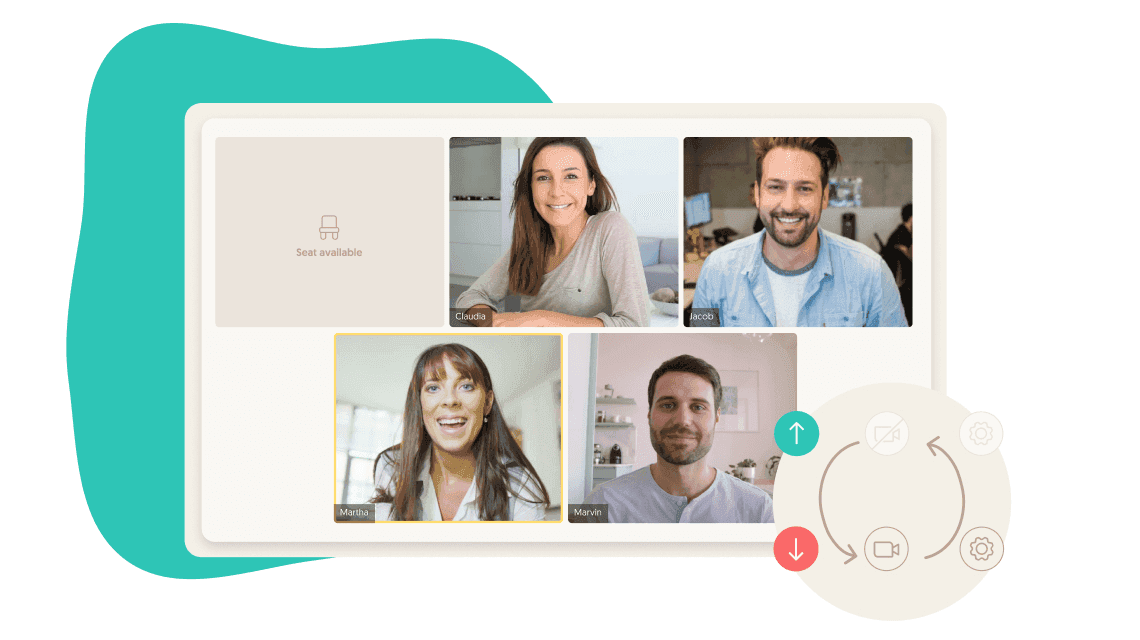
For the creation of Stooa, we followed the Lean methodology. A method originating in 1970s Japan with the TPS (Toyota Production System), focusing on identifying and enhancing value creation by minimizing waste or time loss (waste). According to this system, the success of a product, service, or business model depends on how skillfully we iterate it based on the feedback received from testing, before running out of resources. The key to minimizing waste is to learn (as much and as quickly as possible) about the customers.
How did we start this learning?
To explore the viability of an idea, the first thing to do is validate if the problem we aim to solve is a real problem for someone. In other words, if we have found a problem worth solving. In the Lean universe, this phase is known as problem-solution fit or empathy.
Our experience when attending online unconference events is that it is very difficult to have an orderly, fluid, and intelligible conversation if there are more than five people in the room. So we set out to validate the following problem: Are specific online tools needed for participatory and self-organized events? Is it a shared concern?
To find out, we relied on the theoretical framework proposed by Ash Maurya in Running Lean and followed these steps:
1. We created a Lean Canvas
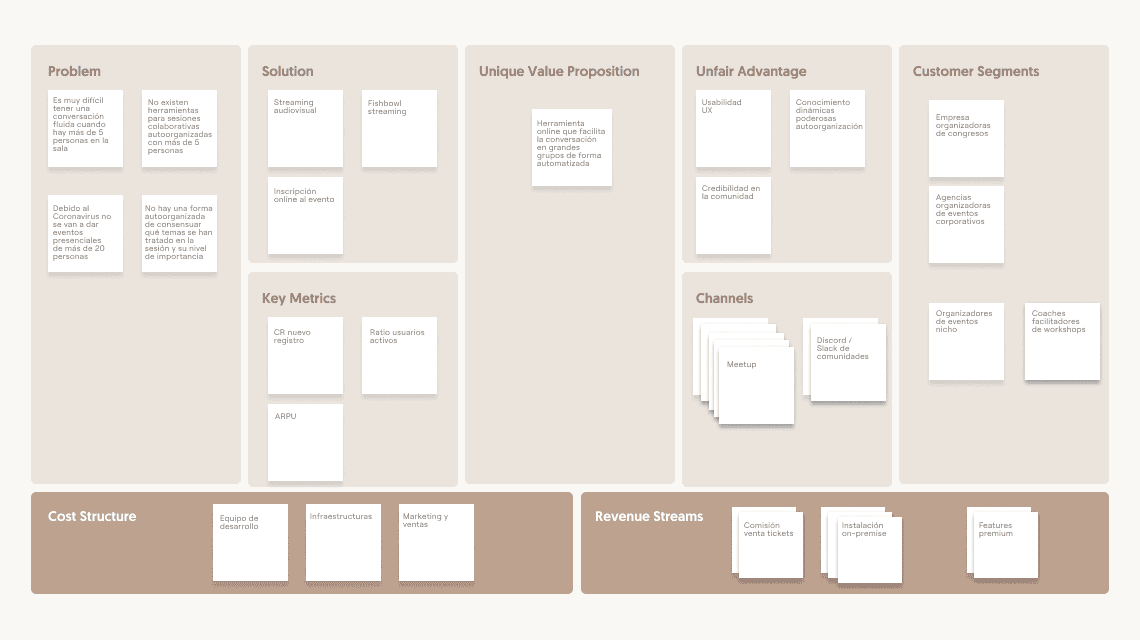
Lean Canvas (inspired by Alexander Osterwalder's Business Model Canvas) is a tool designed to conceptualize business models for projects with high uncertainty. On a single page, it provides an overview of the key aspects involved and how they relate to each other. Being a schematic and concise diagram, it allows for easy changes and tracking of learning as it is obtained. This is the Lean Canvas
of Stooa, the original canvas where we poured all the learning that would come later:2. We validated the problem through interviews (The Problem Interview
)Once the Lean Canvas
was designed, we needed to find out if our business model was based on a problem worth solving. We used problem interviews with potential customers to validate if the need we had detected actually existed.Following the script structure proposed in Running Lean
, aimed at obtaining unbiased information from hypothetical customers, we conducted ten 30-minute interviews with various stakeholders, such as Miquel Rodríguez, Marc Mauri, or Jose E. R. Huerta, to find out their experiences and main pains in online unconference events:The conclusion of the interviews was that the problem did seem to exist and that, therefore, it made sense to explore a possible solution!3. We created a prototype for a possible solution
At this point, we already knew that specific tools were needed to facilitate online
unconference
dynamics. Among the existing ones (dot voting, World Café, speed dating, open space, etc.), we chose the fishbowl as it is closely linked to Runroom's culture.We conducted a one-week Design Sprint
in which, collaboratively, we created a prototype of what would eventually become Stooa. We presented this first interface to the same stakeholders we had interviewed so they could interact with it and provide feedback.4. We validated the solution through interviews (The Solution Interview
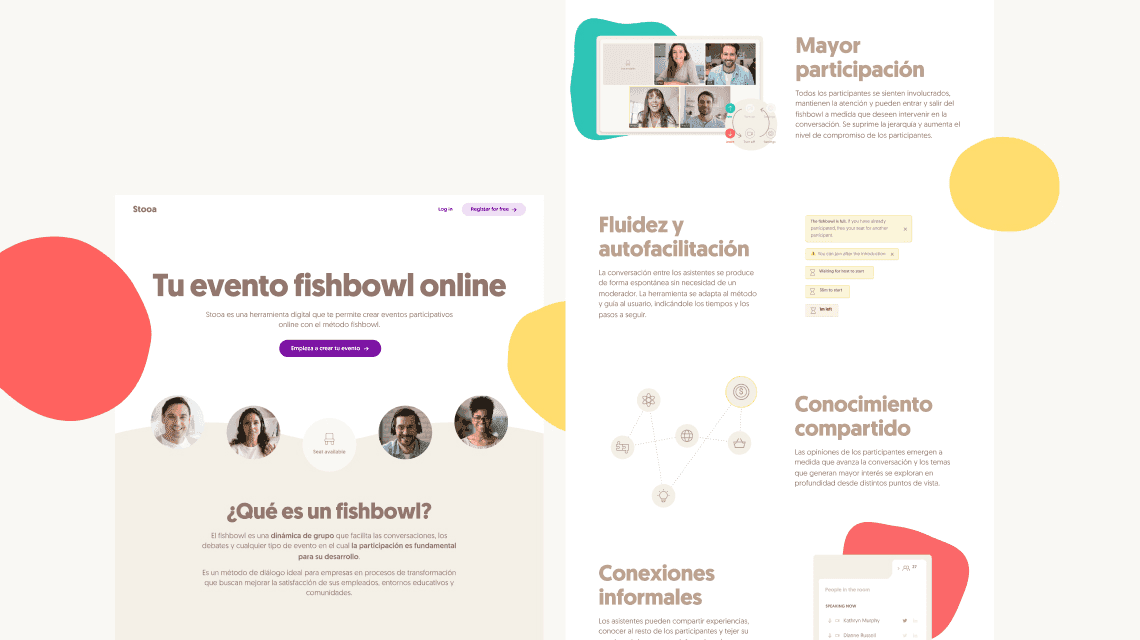
)To capture their impressions with the Stooa prototype, we conducted what are known as solution interviews
, aimed at validating whether the proposed solution effectively solves the problem. As with problem interviews, it is crucial to define hypotheses and subject them to judgment. After conducting the ten interviews, we gave them a quantitative survey to determine if they would be willing to pay for a product like Stooa. Once all the information obtained from the interviews and surveys was analyzed and synthesized, there was something to celebrate: the Stooa prototype seemed to be a good approach to solving their problem, and they would be willing to pay for it! That was the starting signal to develop our MVP, the minimum set of features that Stooa needed to satisfactorily address the
pains
currently associated with online unconference dynamics.From an agile

“Stooa nos ha permitido explorar una nueva forma de realizar debates virtuales en el marco del proceso participativo Barcelona Demà. Frente a la unidireccionalidad de los webinars, el formato de fishbowl consigue dos objetivos fundamentales: introducir un mayor dinamismo y una mayor pluralidad de opiniones.”
“Lanzar un MVP de un producto digital para poder validar las hipótesis planteadas lo antes posible, sobre todo las erróneas, no puede ser de otra forma que con la metodología Agile. Fail Fast, Fail Cheap, Fail Happy!”
perspective of early and frequent value delivery, we conducted an iterative and incremental development of Stooa, systematically prototyping and testing. We developed the first MVP of Stooa in six sprints
of two weeks, with user tests to validate its main functionalities. To do this, we set up a cross-functional team composed of multiple roles and profiles (business, frontends, backends, researchers, designers, etc.) that changed throughout the process without affecting the product's quality or delivery schedule. On February 12, 2021, we launched Stooa at an event that couldn't be more representative, “20 years of the Agile Manifesto
”, three online fishbowls where we discussed the evolution of "agility" and the different ways of understanding it.Although its development continues, today Stooa is a reality, and some organizations like PEMB (Pla Estratègic Metropolità de Barcelona) are using it to facilitate their participatory processes
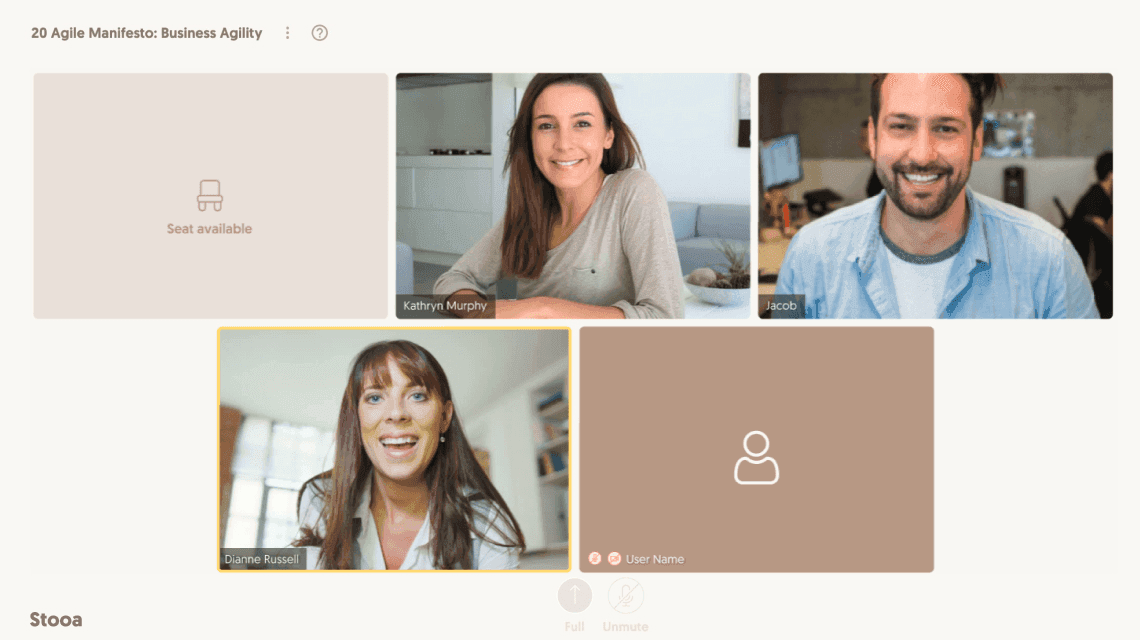
. At Runroom, we couldn't be happier to have developed a tool so aligned with our values that allows for open, fluid, and self-managed conversation, connecting us with current friends and those yet to come. But the work doesn't end here: with more enthusiasm than ever, we aim to validate the market-solution fit
of Stooa and enter the adherence phase of this long journey. With this goal, at the end of November 2021, we turned Stooa into an Open Source product and opened it to the international developer community through platforms like Product Hunt and Hacker News. An opportunity to give back some of what we have received over the years! We invite you to read the newsletter Product Hunt dedicated to Stooa during its launch: "The fishbowl method at work"
.Our next steps are to introduce Stooa to virtual communities, continue generating value, and achieve an Open Source product aligned with Runroom's collaborative culture. To be continued…!
Nuestros próximos pasos son dar a conocer Stooa a comunidades virtuales, seguir generando valor y conseguir un producto Open Source alineado con la cultura colaborativa de Runroom. To be continued…!
More success stories




Let's talk
Tell us about your challenge, and we'll explore how to turn it into a growth opportunity together.