Realworld
The staff nobody hired · Talent Open Space 2026
There are agents working inside organisations that nobody in People has told how to behave. This is one of the sixteen conversations that came out of the Talent Open Space, and the one we expected least.
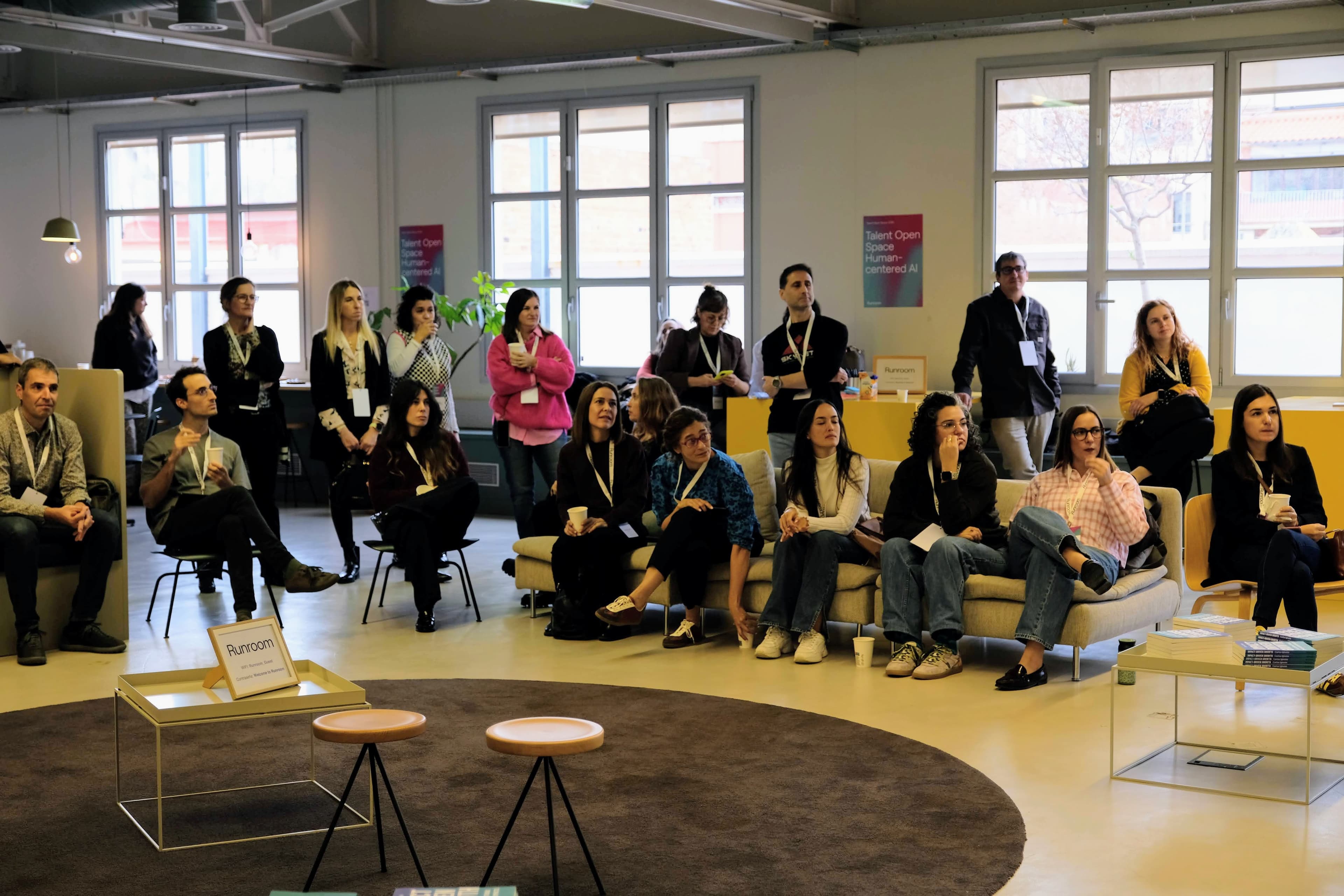
On 5 November, at 9:30 in the morning, there was no agenda at Runroom. There were fifty people who mostly did not know each other, an empty board and a handful of markers.
By 10:40 there were sixteen sessions across four rooms, all of them proposed and voted on by the people who were there. That is how an Open Space works: the topics come from whoever shows up, they are voted on at the start, and the morning is built out of what comes up.
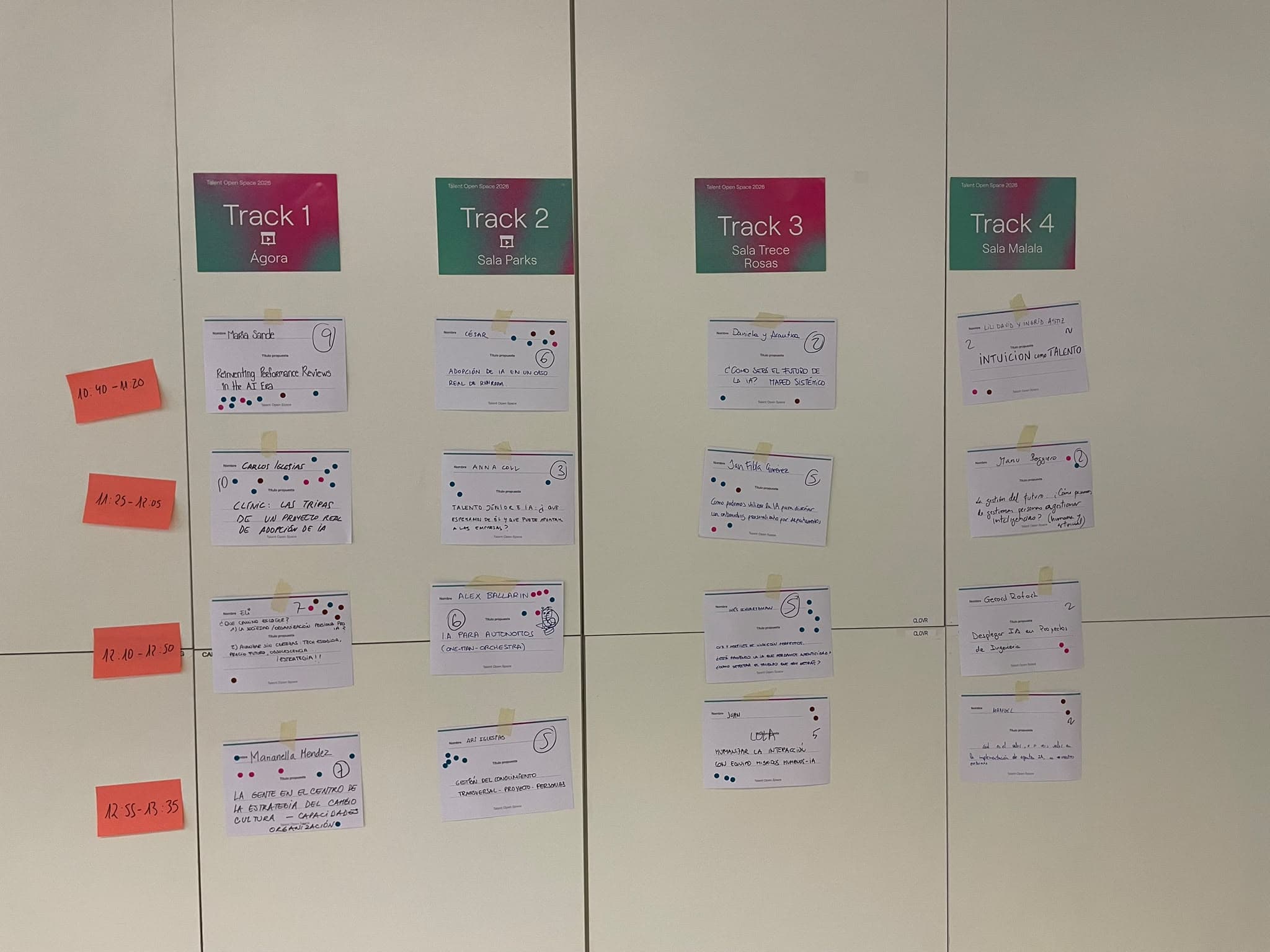
We convened this edition around two themes that kept recurring in our conversations with People leaders: training, onboarding and talent development, and knowledge management in the age of AI.
Those sixteen sessions produced sixteen rich conversations and this article follows only one of them. It is the one we least expected to find in a room full of People and Talent professionals, and the one still going round our heads a week later.
The part nobody owns
In several organisations there are already AI agents carrying out critical tasks. They write user stories. They generate code. They prioritise work. They decide the order in which things get done.
Someone configured those agents. And that someone has almost always been a technical profile.
Nobody from People has taken part in defining how they behave, what criteria they apply, what biases they carry or what tone they use when they interact with the team. They have joined the organisation without going through any of the conversations that any person joining a company goes through.
It is a workforce nobody hired. It works, it decides and it affects the rest of the team, and it appears on no org chart and in no internal policy.
The result shows up later and is hard to trace: decisions that do not fit the culture, criteria nobody remembers approving, and a team that senses the rules changed without anyone telling them.
An AI talking to another AI
The same dynamic shows up somewhere far more everyday: performance reviews.
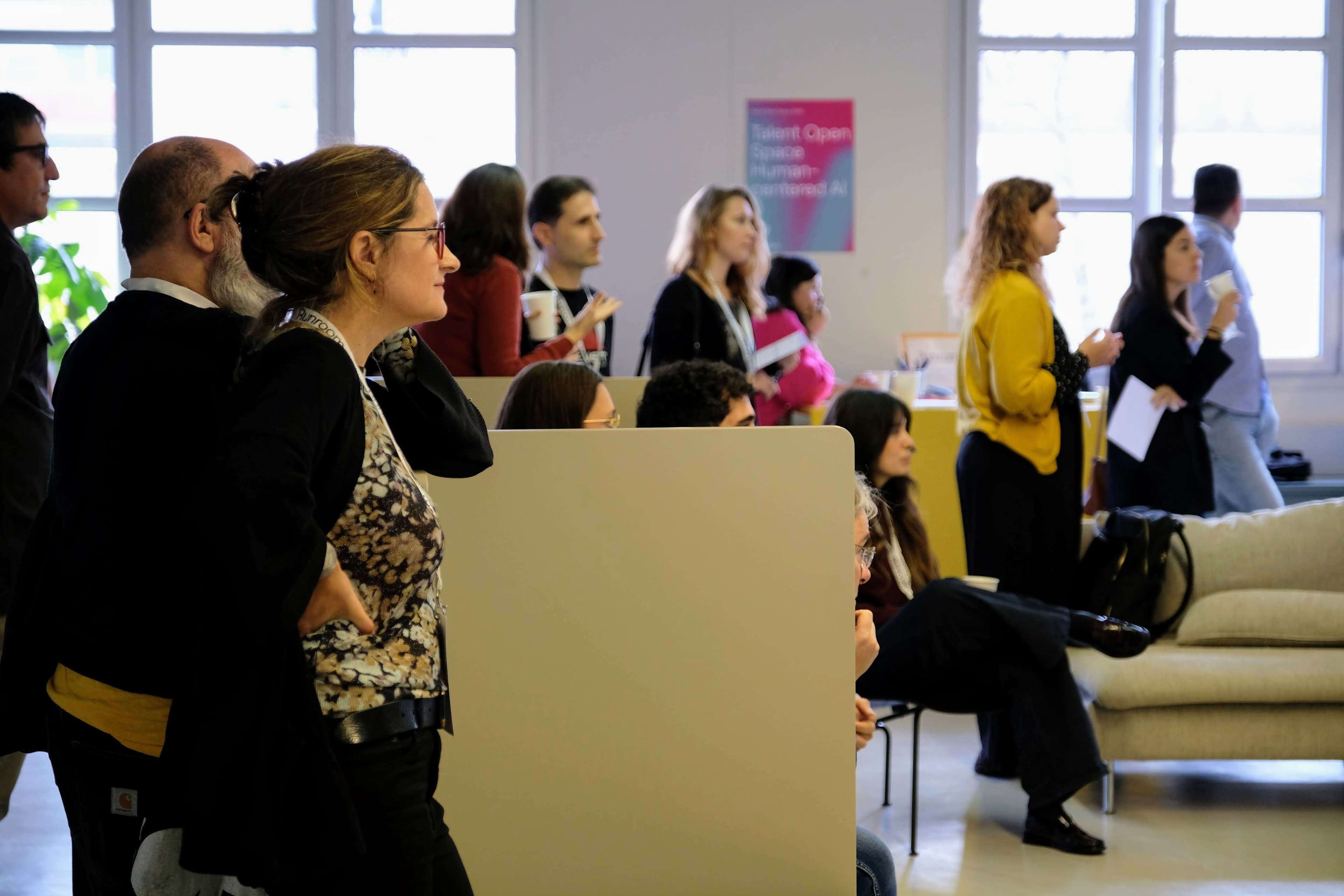
In the session on reinventing performance reviews, a pattern came up that is becoming common in large companies. The manager prepares the conversation with AI. The person being reviewed prepares theirs with AI. And you end up with an AI talking to another AI, in exactly the conversation that most needed to be human.
Around that, something deeper came up: what a performance review is actually for. There was broad agreement that, as applied in most companies, it has ended up as a control tool tied to the bonus or the salary increase. The question is not the tool, it is what gets done with it afterwards. Whether it serves to make decisions about the person, or to help the person grow.
There is a second effect, and it is more uncomfortable. More and more one-to-ones and reviews are recorded so that AI can process them later. That shapes what people share. And where there is no prior psychological safety, the tool reads as surveillance and the answers turn defensive.
It is worth knowing that this already has a legal framework in Europe. The EU AI Act classifies as high risk the systems used to make decisions about working conditions, promotion or termination, and those that monitor and evaluate the performance or conduct of workers. It directly prohibits emotion inference in the workplace, with narrow exceptions on medical or safety grounds. GDPR sits on top of that. What is missing is not regulation. It is knowing how to apply it.
The opposite use came up too, and that one is the hopeful part. Some people build their own tools to analyse their own participation in a committee: whether they talked too much, whether they listened, how they intervened. The same data, used to look at yourself instead of to watch everyone else. Great idea!
The annual budget turned up twice
There is a detail you only see when you put two separate sessions side by side.
In the performance review session, the underlying problem was the annual bonus tied to the evaluation. In the session on which path to take for an AI strategy, the underlying problem was the annual budget: twelve-month planning cycles are still being used for a technology with variable costs that changes every quarter. The barrier that came up most in that room was the fear of investing a lot of money and ending up with nothing useful.
The same alternative appeared in both conversations, Beyond Budgeting, where the company sets an ambition and a set of metrics and the bonus is the same for everyone.
That is no coincidence. It is the same governance structure, designed for an annual rhythm, applied to decisions that are now made every week.
That produced the most useful shift of the morning: the question is not how much to invest in AI. It is how to reduce the risk of investing. Small bets, measured and reversible, built on your own knowledge, generating the internal evidence that convinces the organisation.
Resistance is not technical
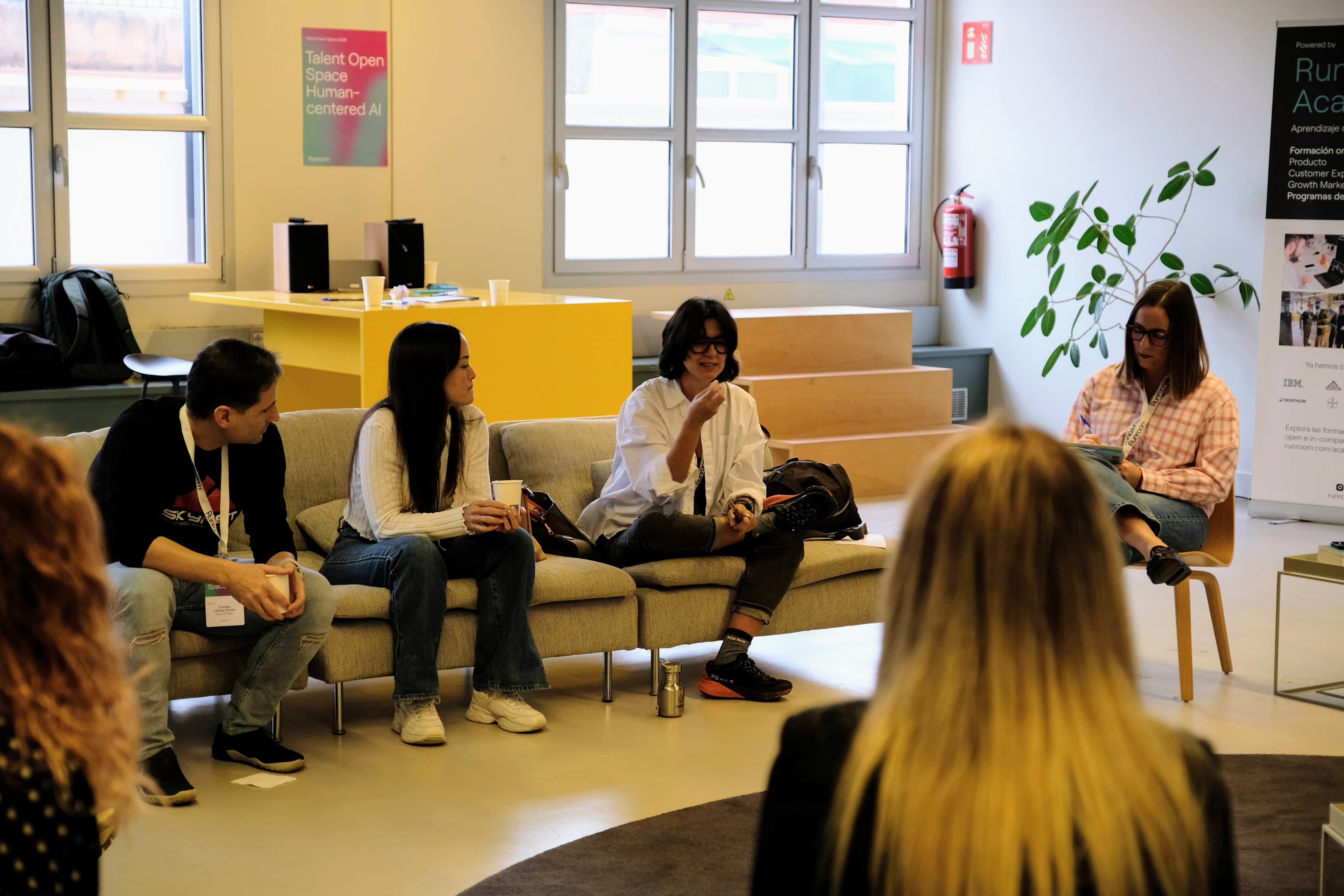
In one of the rooms someone said that adopting AI is no longer optional, and that you either adopt it or you are left behind. In that same room there were people describing reluctance in their companies, fear of sharing information, and the sense that sharing what you know costs you power.
Those two things together explain a good deal of where we are.
What holds adoption back is almost never the technology. It is that knowledge is trapped: in silos, in minutes nobody reads, in the heads of three people who are busy. And part of that trapping is deliberate, because whoever holds the knowledge senses that sharing it takes something away from them.
There is a second driver, and it came up in another room. Many organisations penalise mistakes, and that produces conservative cultures where people would rather not take a risk and end up singled out. When trying something new carries a personal cost and not trying carries none, the organisation chooses to stay still without anyone deciding it.
That is a problem belonging to People and to nobody else. Building the infrastructure for knowledge to circulate is the easy part. Getting someone to want to let go of it, and to dare to use it, is the hard part.
And it has a practical consequence that came up in several sessions: part of "AI is useless" comes from putting AI on top of a company whose knowledge is not in order. With no real context, AI answers in generic terms, and the investment looks pointless.
What we took away
As we closed the morning we asked everyone there to write down what they were taking with them. The wall ended up like this:
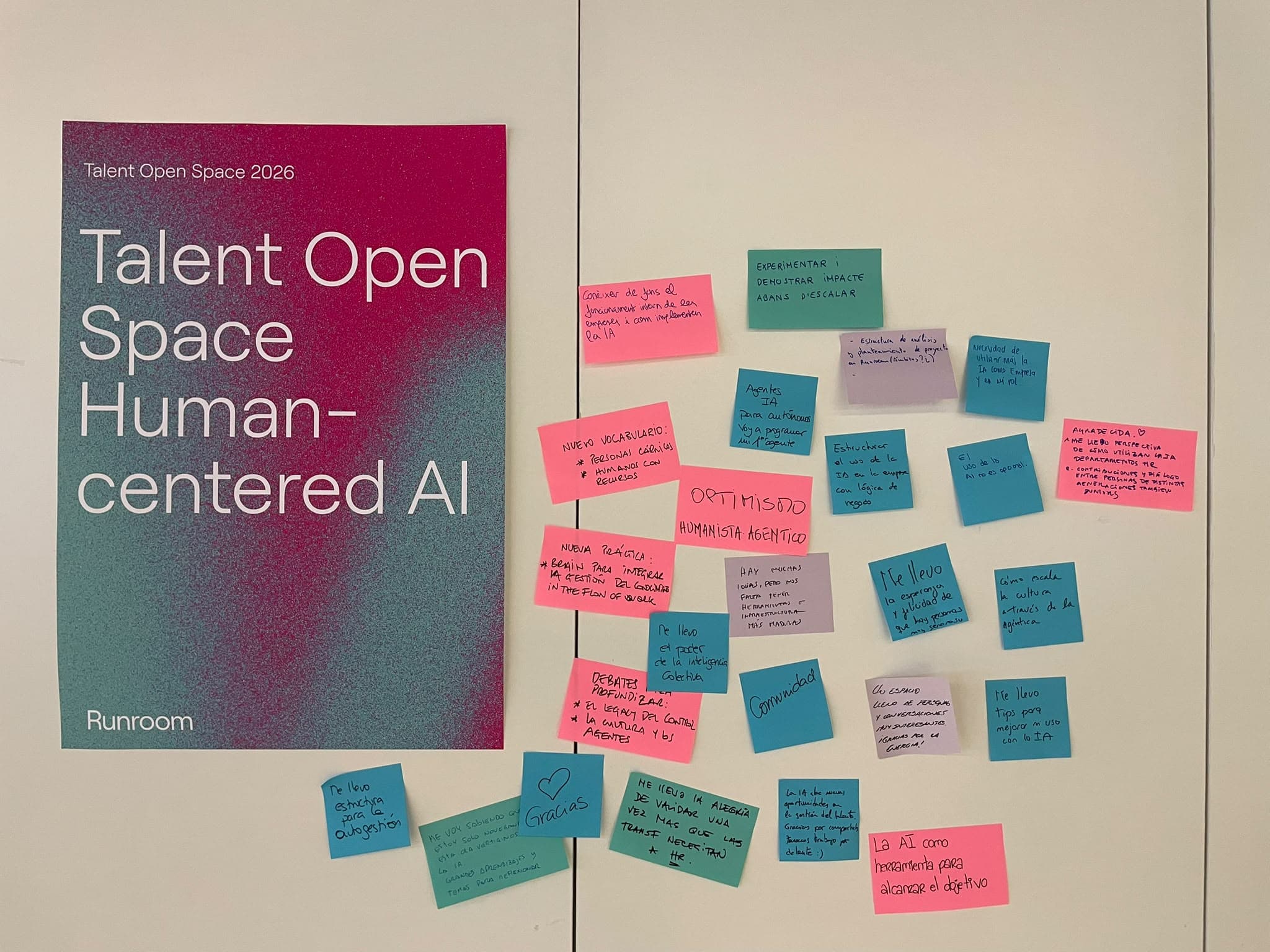
"I'm taking away the power of collective intelligence."
"I'm leaving knowing I'm not navigating this dizzying AI wave on my own."
"New vocabulary: personal cárnicas, humanos con recursos."*
"Agentic humanist optimism."
"Using AI is not optional."
"I'm taking away the joy of confirming once again that transformations need HR."
"There are plenty of ideas, but we lack more mature tools and infrastructure."
*The third one is a Spanish play on words. "Recursos humanos" (human resources) flipped into "humans with resources", alongside "personal cárnicas", which turns the HR word for staff into something closer to meat and bone.
The wall was not there for pats on the back, and we value that in particular.
The questions left open
An Open Space does not close topics. It leaves them better framed.
Two were written on the wall as pending debates: the legacy of control and culture and agents. They are the same question along two routes. Who decides how the thing that works inside your organisation behaves, and what happens when that decision is made without People in the room. We took note, because they could be a good starting point for the next Talent Open Space in 2027.
If your company already has agents carrying out tasks, three questions are worth asking before the next conversation about tools:
- Who defined how they behave, and on what criteria?
- Has anyone from People seen those instructions?
- If tomorrow one of those agents makes a decision that contradicts your values, who answers for it?
Technology does not wait for the org chart to agree. That is the uncomfortable part. The good part is that this conversation is already happening, and that the fifty people who were there on 5 November left with the same feeling: this is not something you solve on your own.
The Talent Open Space is a free, in-person event. It runs once a year and places have to be booked in advance. The next edition is 14 October 2027.
Let's talk
Tell us about your challenge, and we'll explore how to turn it into a growth opportunity together.