Realworld
Product Open Space 2026: From Insights to Impact in the AI Era
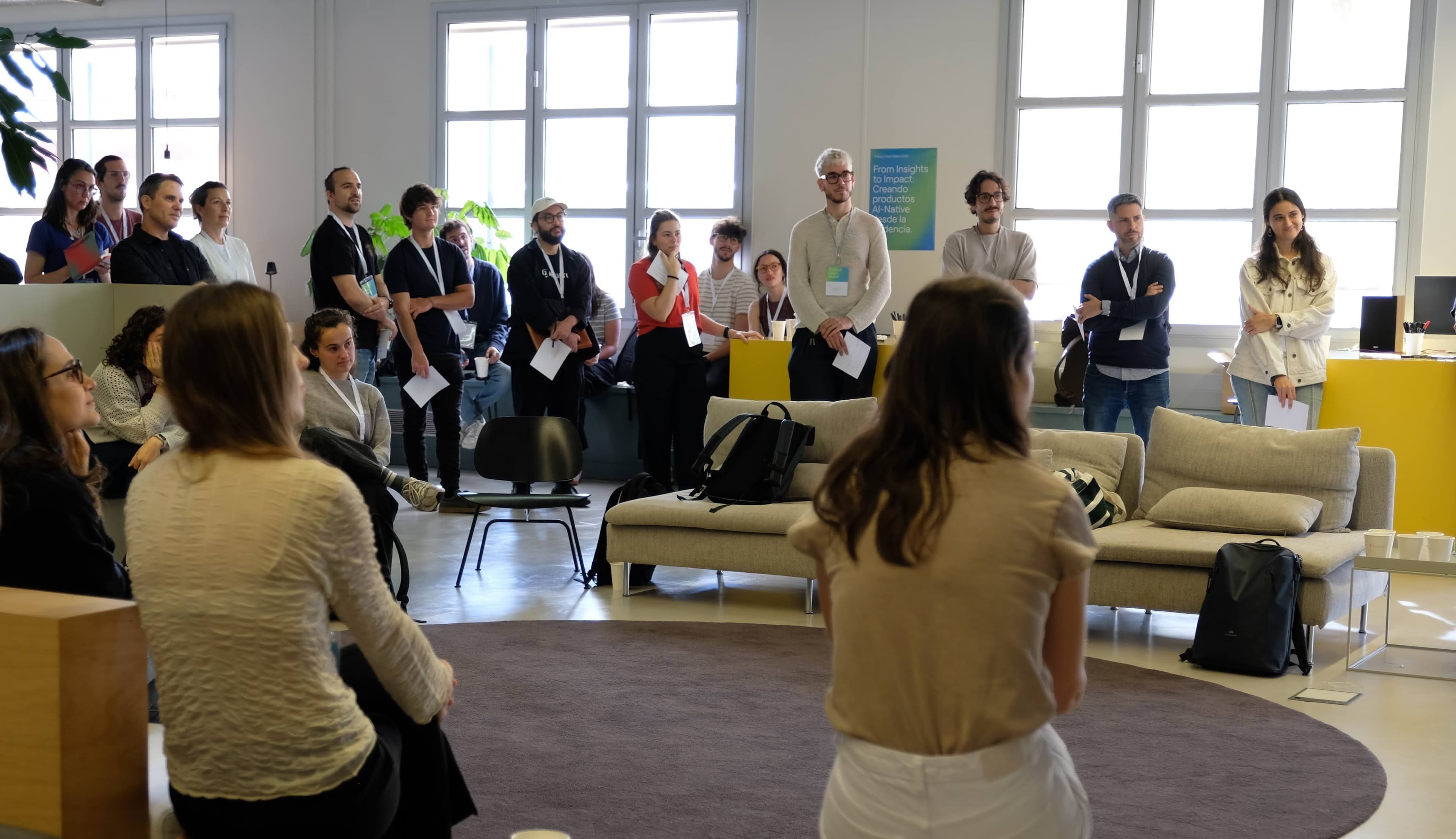
On April 17th, at Runroom, we brought together professionals from product, design, business, and technology in a new edition of Product Open Space: From Insights to Impact.
It wasn't just another event. It was a space to share real doubts, current tensions, and uncomfortable questions about the future of product in the AI era.
And if I had to sum it up in one idea: we are in transition. And we know it.
Community, transition, and the human factor
From the start, there was something special in the air. Excitement, yes. But also uncertainty.
Many attendees shared this duality: enthusiasm for what's coming, and at the same time, concern about how it will transform our professions.Montse Pachón, Head of Operations at Runroom, described it well: “There were people excited, people scared… and many of us were both at the same time.”
As Laura Polls, Head of Experience Research at Runroom and Director of Runroom Academy said, “the challenge ahead is not purely technical, but profoundly human”.
Montse also pointed out something key: “We tend to think our current role is indispensable, but the healthiest thing is to assume that all roles will transform.” And this is where one of the first major conclusions appears: we are not just facing a change of tools, but a change of mindset.
César Úbeda, CXO and co-founding partner at Runroom, summarized it well: many organizations are trying to incorporate AI over past structures, instead of rethinking their processes from the ground up.
.JPG&w=3840&q=75)
Can product push code to production?
One of the most intense debates revolved around this question, posed by Pau Jorba, Senior Product Manager at Vivara.
The conversation went far beyond the technical. We talked about professional identity, roles, and how value is redefined in teams.
Carlos Iglesias, CEO and co-founding partner at Runroom, expressed it this way: AI-generated code is not yet completely reliable, but the window of evolution is short - between 1 and 5 years.
This created some friction, especially among technical profiles who see how the focus might shift towards validation rather than construction.
In the future, a different scenario is drawn: product creation as a continuous conversation between disciplines, where writing code is no longer the center.
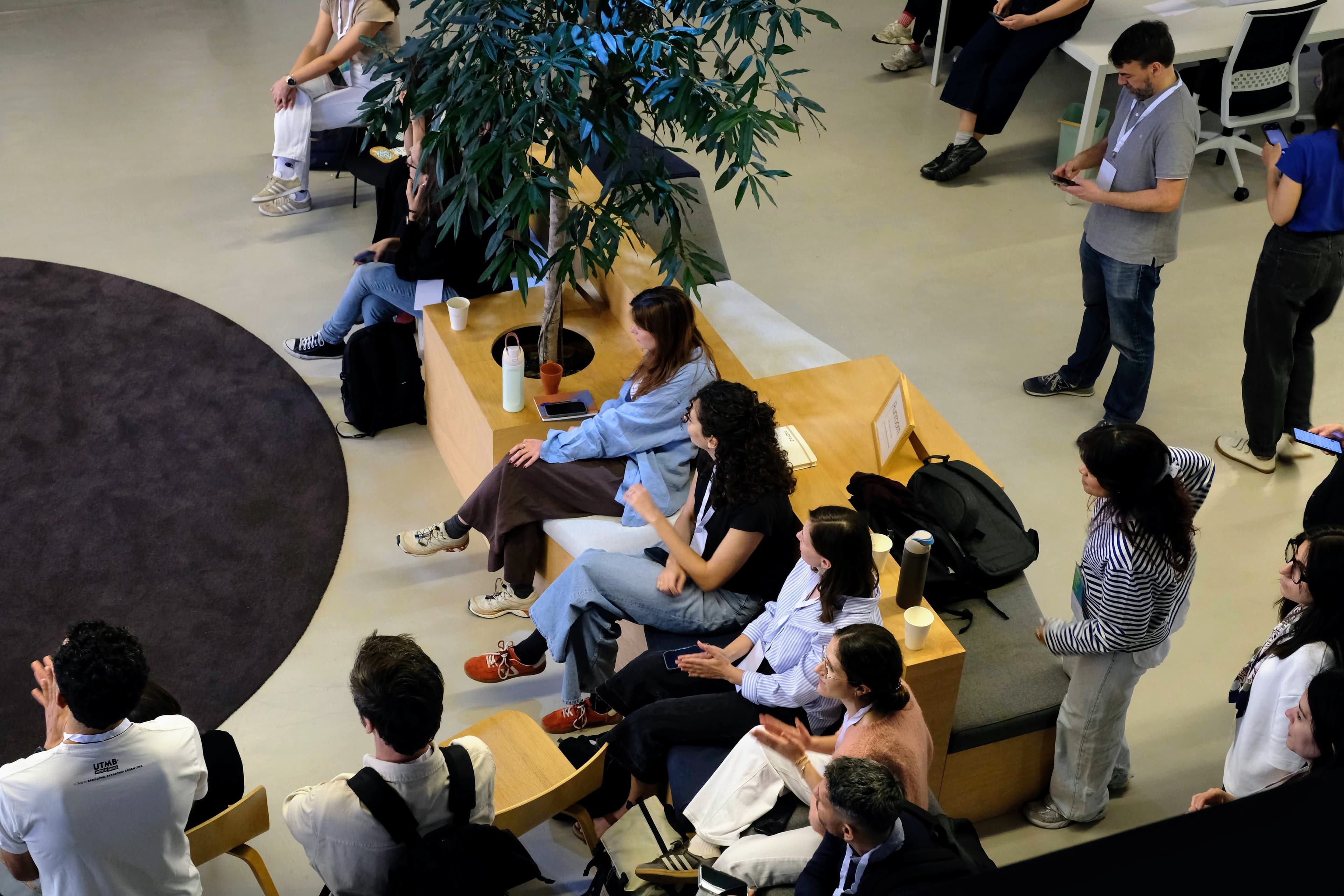
New squads, new roles
The session by Adrià Rauret (Director of Engineering at Mango) took this debate a step further: what will teams look like when AI is at the center?
The possibility of much smaller teams was even raised - up to a single person supported by agents - capable of covering the entire product cycle.
This is not so much a closed prediction as a provocation: it forces us to rethink what value we really bring in each role.Jordi Hernández, CIO and co-founding partner at Runroom, summarized it with a provocative idea: “Rather than asking how many people a team needs, we should ask what capabilities remain truly human.”
Design, judgment, and the risk of “disempowerment”
Another key topic was the potential loss of judgment.
Carme Alcoverro, Product Designer at Runroom highlighted an especially interesting idea: using AI itself as a defense mechanism.
Configuring it so that, when it detects excessive delegation, it returns questions that force us to think.
Because if anything was clear, it's that the differential value is not in producing faster, but in better understanding the problem.
Jorge Valencia, Head of Experience Design at Runroom, summarized it clearly: if AI already gives us a standard result of “7/10,” the role of design moves towards two extremes:
- Defining systems and rules (taking the product to a 9/10)
- Breaking patterns with creativity
Strategy, impact, and tough decisions
There was also space to talk about what we often avoid: stopping building.
The session by Xavi Belloso (Software Engineer at baVel - Voxel Group) introduced a powerful idea: planning the “destruction” of the product from the start.
Deciding when to stop investing, evaluating:
- If it meets a real need
- Its technological cost
- Its business sense
- The level of risk assumed
In parallel, the session by Laura Tellería, Strategic Product Designer at 540, brought a key distinction to the table: strategy is not planning.
And here we connect with one of the event's axes: Impact Driven Growth™.
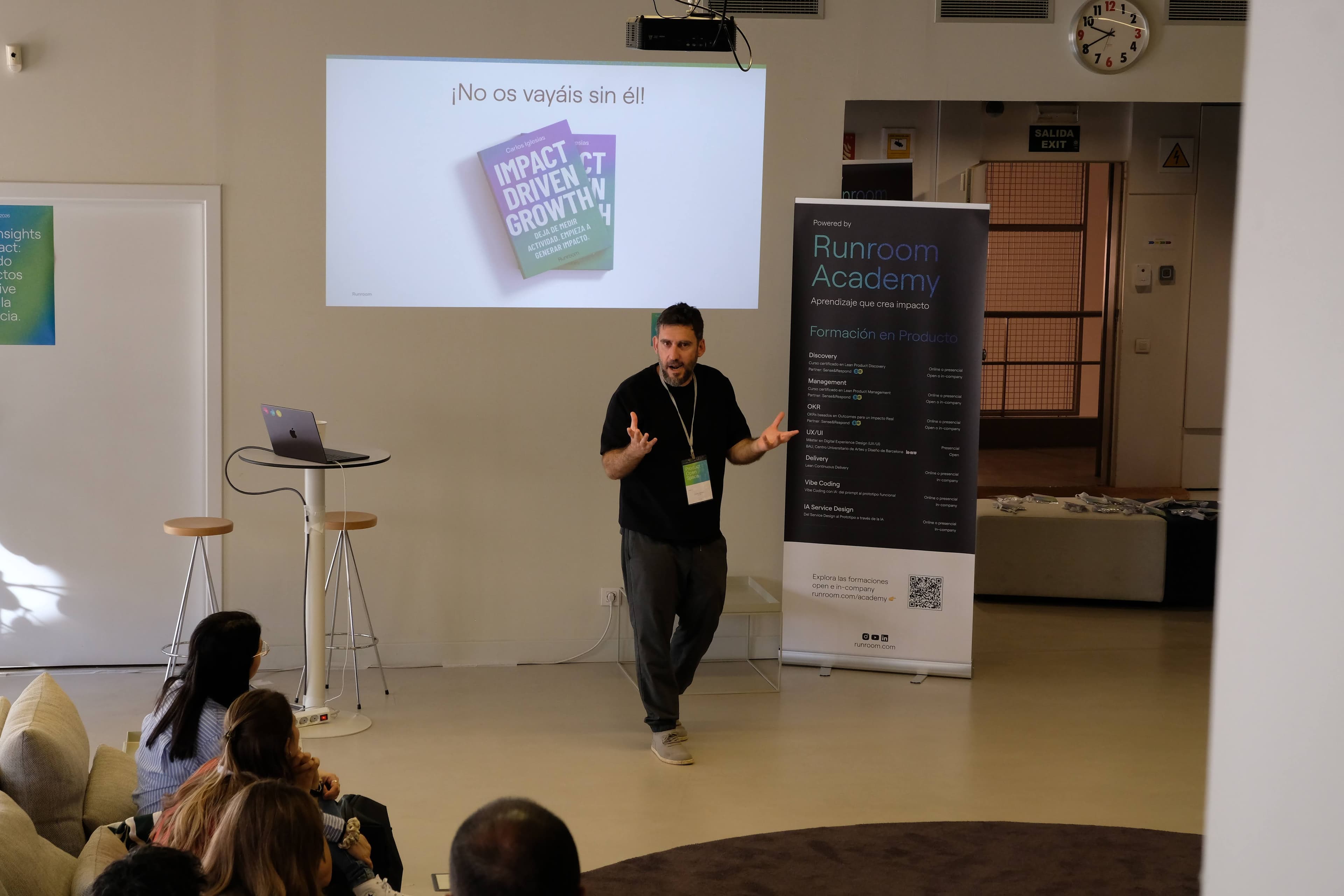
Speed, quality, and judgment in the AI era
Another major debate revolved around a tension that is not new, but now intensifies: speed vs. quality.
AI allows us to do more things in less time, but that doesn't always mean doing it better.
As Carlos Iglesias pointed out: “The easier it seems to produce, the more important it becomes to know how to judge.”
This is where Impact Driven Growth™ becomes especially relevant: it's not about doing more, but about doing what truly generates impact.
In this context, skills like critical thinking, the ability to formulate good questions, and a deep understanding of the problem become central.
And a shared concern arises: how do we develop junior talent when traditional learning tasks disappear or change?
If building is easy, the challenge is distribution
One idea was repeated in several sessions: creating products has never been so easy.
But that makes standing out much more difficult.
Gastón Valle, Lead Product Manager at Voxel, addressed it from the distribution and Go-To-Market perspective in the era of “hyper-productization.”
The conclusions were clear:
- In B2B, human interaction becomes key again
- In B2C, brands must be radically different
- Additionally, discovery no longer only happens on our website, but through AI agents
This completely changes the rules of the game.
Ethics, memory, and responsibility
Finally, two fundamental topics:
Human in the loop
In critical areas like HR, AI cannot make decisions autonomously.
Maintaining human oversight is key to avoiding biases.
Organizational memory
Knowledge can no longer depend on the tacit.
We need to build memory layers that allow scaling collective learning.
Conclusion: it's not about technology, it's about judgment
If there's one thing we take away from this Product Open Space, it's that the future of product will not be defined by technology, but by how we use it.
We are entering a stage where:
- Building is easier
- Deciding is harder
- And judgment is the most valuable asset
And that's why, more than ever, we need spaces like this.
If you missed it, we look forward to seeing you at the next edition. Runroom organizes 3 Open Spaces a year:
Product Open Space - in April
CX Open Space - in June
Growth Open Space - in October
Check the dates of upcoming events We look forward to seeing you at Runroom!
Let's talk
Tell us about your challenge, and we'll explore how to turn it into a growth opportunity together.